

Snap-on Dentures vs. Implant-Supported Dentures: Which Is Better?
If you are currently wearing traditional removable dentures, you already know the daily frustrations that come with them. Slipping while you talk, worrying that they might pop loose during dinner, or dealing with messy adhesives can really wear on your confidence.
When people start looking for a more secure upgrade, they usually run into two popular terms: snap-on dentures and implant-supported dentures. At first glance, people often use these terms interchangeably, but there are some important differences in how they feel, how they work, and how they stay in place.
If you are exploring your tooth replacement options around Norridge, here is a straightforward breakdown to help you figure out which path might fit your lifestyle and your smile.
Understanding the Basics: What Do They Have in Common?
Before looking at how they differ, it helps to understand what both of these options share. Unlike old-school dentures that just rest directly on your gums and rely on suction or paste, both snap-on and implant-supported styles anchor into your jawbone using small titanium dental implants.
Because dental implants act like artificial tooth roots, they offer a massive advantage that regular dentures cannot match: they stimulate your jawbone. This helps prevent the bone loss and facial shrinking that typically happens over the years when teeth are missing.
However, how those dentures actually connect to the implants is where things start to diverge.
What Are Snap-on Dentures?
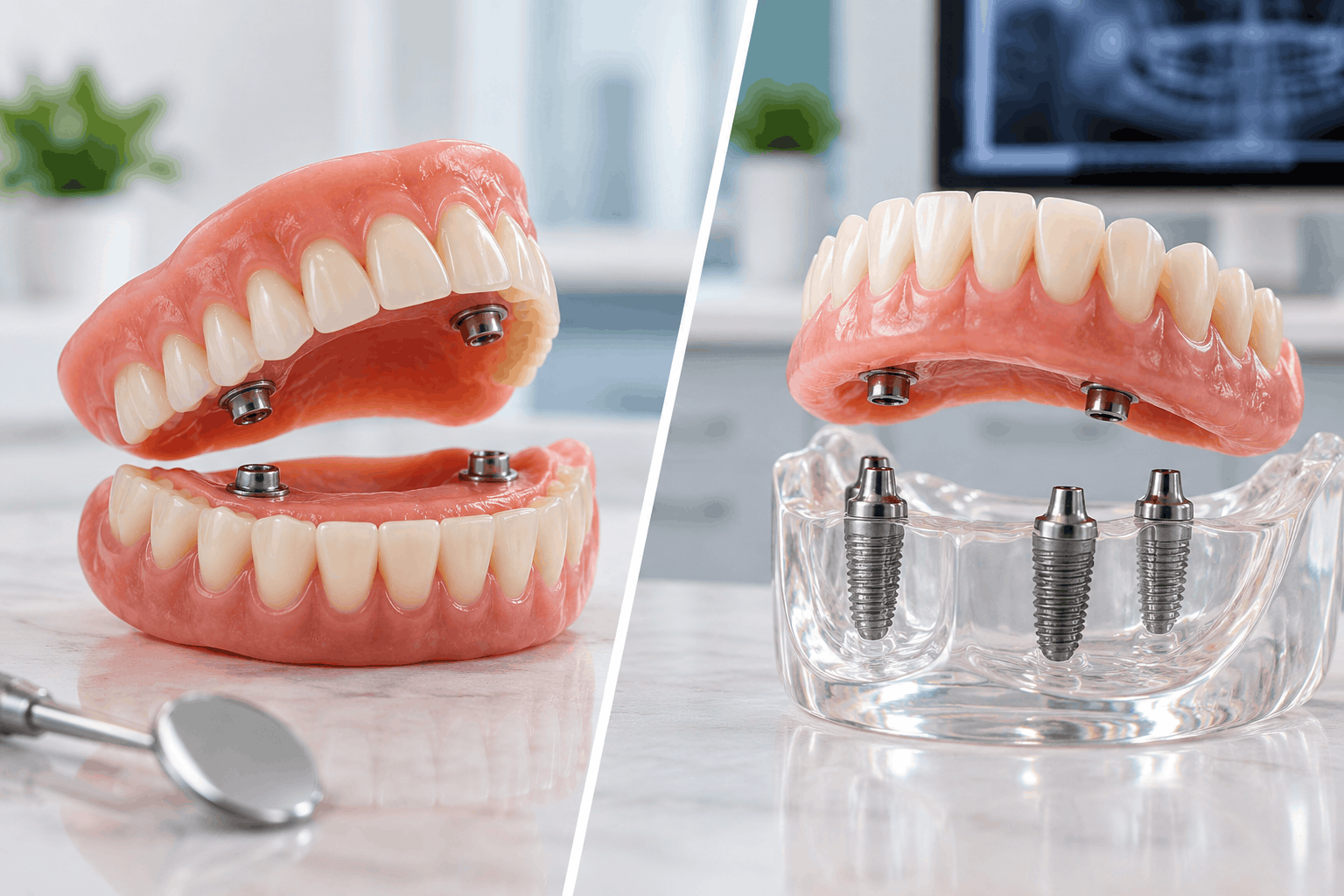
Snap-on dentures, frequently referred to by dentists as overdentures, are a removable type of implant-secured denture.
How They Work
Typically, a dentist places between two and four dental implants in your jaw. The bottom of your new denture is fitted with special attachments, often called locators or ball attachments, that literally snap right onto the tops of the implants.
The Pros
- Much more secure: They click firmly into place, meaning you can laugh, speak, and chew without worrying about them sliding around.
- Easy to clean: Because you can take them out whenever you want, cleaning your mouth and the appliance itself is quite straightforward.
- More affordable: Requiring fewer implants than fixed alternatives makes snap-ons a budget-friendly way to step up from traditional dentures.
The Cons
You still take them out: You do need to remove them every night for cleaning, just like standard dentures.
Some movement: While they snap securely onto the implants, they can still exhibit a tiny bit of vertical movement or rocking compared to fully fixed arches.
What Are Implant-Supported Dentures?
When people talk about implant-supported dentures in a broader sense, they are often referring to permanent, fixed hybrid bridges, sometimes known as All-on-4 or fixed implant dentures.
How They Work
This approach usually involves placing four or more implants per jaw. Instead of snapping in and out of your mouth, the denture is permanently screwed or bolted onto the implants. Only a dentist can remove them during routine checkups.
The Pros
- Feels closest to natural teeth: Because they are completely fixed in place, there is zero movement when you eat or talk.
- No nightly removal: You brush and floss them right in your mouth, just like natural teeth.
- Maximum stability: They restore almost full chewing power, letting you enjoy crunchy apples, steak, and nuts with confidence.
The Cons
- Higher upfront cost: Because they require more implants and specialized lab work, the investment is generally higher.
- More complex maintenance: Cleaning underneath a fixed arch requires special floss threaders or water flossers, which takes a little practice.
Snap-on vs. Implant-Supported: Direct Comparison
Choosing between the two usually comes down to a few personal priorities:
Removability
- Snap-on Dentures: Removable (you take them out nightly)
- Implant-Supported (Fixed): Fixed (only removed by a dentist)
Number of Implants
- Snap-on Dentures: Usually 2 to 4
- Implant-Supported (Fixed): Usually 4 to 6+
Stability
- Snap-on Dentures: Very secure, minor movement possible
- Implant-Supported (Fixed): Completely rigid and stable
Cleaning Routine
- Snap-on Dentures: Out of the mouth for easy cleaning
- Implant-Supported (Fixed): Brushed and flossed right in the mouth
Cost Investment
- Snap-on Dentures: More moderate
- Implant-Supported (Fixed): Higher
Call Royal Dental Care Norridge Today
Deciding how to upgrade your smile is a big step, and you do not have to figure it out on your own. If you are tired of loose dentures and want to explore what snap-on or implant-supported options can do for you, give our Norridge office a call. We will take a close look at your oral health, discuss your goals, and help you choose a solution that lets you eat, speak, and smile comfortably again.
Frequently Asked Questions on Snap-on vs. Implant-Supported Dentures
Q: Can my existing dentures be converted into snap-on dentures?
A: In some cases, if your current dentures are in great condition, a dentist might be able to retrofit them with attachment housings. However, most patients get better long-term results with a new denture specifically engineered to work with dental implants.
Q: Does getting implants for snap-on dentures hurt?
A: The procedure is performed using local anesthesia to ensure you stay comfortable. While you can expect some mild soreness and tenderness for a few days after the procedure, most patients find it very manageable and well worth the result.
Q: How long do snap-on dentures last?
A: The underlying titanium implants can last for decades with good oral hygiene. The denture appliance itself experiences normal wear from chewing and may eventually need relining or replacement after several years.
Q: Are implant-secured dentures hard to keep clean?
A: Not at all, but the routine depends on which style you choose. Snap-on dentures are simple because you just pop them out to clean them. Fixed implant dentures require brushing and using special floss threaders to clean underneath the arch daily.
Real Patients. Real Reviews.



Luke
1 year ago
Isabella was great!! Highly recommend her

Julia Swider
1 year ago
Great experience, everyone is very kind and patient. Take time to educate you on what is going on, which is much appreciated. Highly recommend!
Response from the owner
Hi Julia,
Thank you for leaving us a review! Your feedback is appreciated.2 years ago

Pawel Blaszczak
1 year ago

Casey Kinsella
1 year ago
The atmosphere was great. The professionals were friendly. The communication between the office, dentist and patient was awful. I’ve found this with most dentist offices that once they get your money, they forget about you. Not happy with the customer service.

Scott Donaldson
1 year ago

Szymon Szuster
1 year ago

Ozzie Skenderi
1 year ago
Everyone is so nice and helpful!! They are great!!
Response from the owner
Hi Ozzie,
We appreciate you taking the time to provide your feedback. We're happy to hear you had a positive experience at our practice!2 years ago

Jacqueline Hernandez
1 year ago
Really clean and great service

Rafal Raszewski
1 year ago

vivian trankina (viv)
1 year ago
amazing service everyone is kind here i’ve been going here for about 2 ywars

Keluarga Bahagia
1 year ago
Since I moved from another dentist to this Royal Dental treatment has felt so amazing, all the women who work at the desk are very kind to help me and my husband for scheduling, especially for me a dental cleaner who cleans my teeth Lois is my favorite, she is very friendly and does clean details. The dentist is also good, twice helped by the dentist forgot his name, he is also very helpful to check, for all the good and happy come to this Kingdom's teeth

Karina Czajko
1 year ago
Very professional, always respectful! Highly recommend!

Yoly navarrete
1 year ago
The atmosphere is beautiful the place is very clean. Very professional service. I went in for a free consultation. They were very thorough at explaining everything. I will be coming back and I Recommend them.

Alyssa Silvia
1 year ago
Response from the owner
Hi Alyssa Silvia Thanks for visiting Royal Dental Care. We truly value your feedback and your confidence in our team.
1 year ago

Amreen Jalal
1 year ago
izabela was so sweet and made the entire appointment very easy and enjoyable. the environment was really friendly, welcoming and clean. would definitely recommend to others, they’re very thorough with their work!
Response from the owner
Hi Amreen Jalal Thanks for taking the time to leave a review. Your input helps us continue providing high-quality care at Royal Dental Care.
1 year ago

LUKASZ WROBLEWSKI
1 year ago
This is a great place for those who want a gentle dentist, a thorough hygienist, and friendly staff. Everyone is so nice, and the whole office is clean and modern.
Response from the owner
Hi LUKASZ WROBLEWSKI Thank you for your kind words. We're so pleased to know you had a great experience at Royal Dental Care. 1 year ago

Katherine Dynak
1 year ago
Pretty good service
Response from the owner
Hi Katherine Dynak Your feedback means a lot to our team. We're committed to continuing the excellent care you’ve come to expect. 1 year ago

Melissa
1 year ago
Very friendly staff. Professional, I’ve been coming here for years now
Response from the owner
Hi Melissa We appreciate your support and are grateful you chose Royal Dental Care for your dental needs. Looking forward to seeing you again. 1 year ago

Bobby Anderson
1 year ago
I love this place! Been coming for years. I’ve had a lot of work done lol
Response from the owner
Hi Bobby Anderson Thank you for your kind words. We're so pleased to know you had a great experience at Royal Dental Care. 1 year ago

Rosa Rendon
1 year ago
Very good experience, Israa was amazing and did a great job
Response from the owner
Hi Rosa Rendon Your feedback means a lot to our team. We're committed to continuing the excellent care you’ve come to expect. 1 year ago