
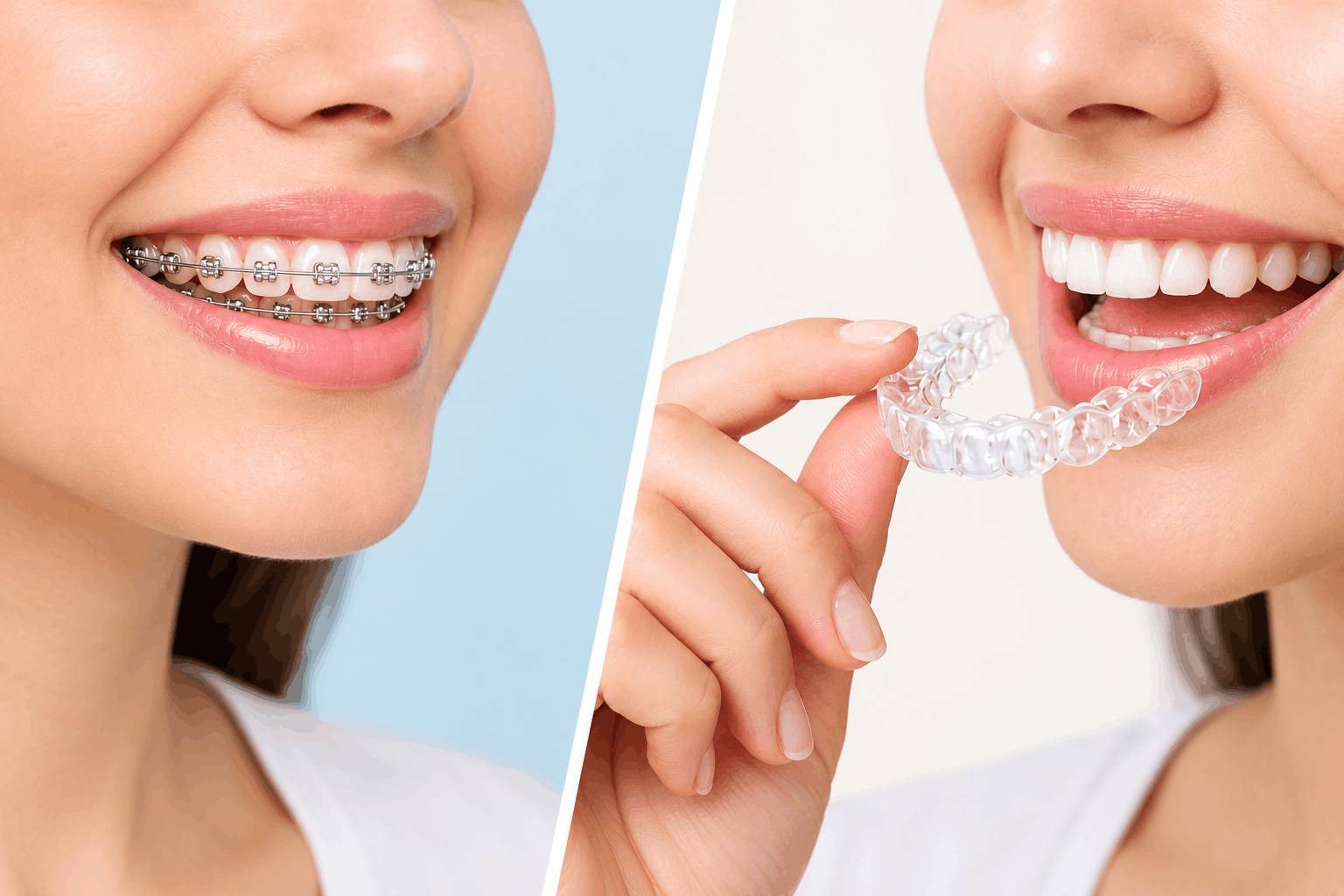

Lingual Braces vs Invisalign: Hidden Orthodontic Options Compared
Imagine checking out your profile in the mirror and thinking, “I love everything about my look, except for that one overlapping tooth or stubborn gap.” You want to fix it, but the immediate mental picture of traditional metal braces flashing back at you from grade school photos makes you hesitate. Thankfully, fixing your smile as an adult doesn’t mean advertising it to the entire grocery store checkout line.
When you start digging into discreet teeth-straightening methods, you almost instantly hit a fork in the road: lingual braces vs Invisalign. Both approaches keep your treatment discreet, but they operate on completely different planets. People constantly debate Invisalign vs traditional braces to figure out which style fits their career and routine, especially when weighing the overall cost of lingual braces vs Invisalign side by side.
If you are currently deep-diving into an Invisalign vs lingual braces for adults comparison, you are likely hunting for unfiltered truth about comfort, speech adjustments, and daily maintenance. At Royal Dental Care in Norridge, we love helping patients sort through the noise. Let’s walk through a comprehensive lingual braces vs Invisalign comparison, looking at how specialized choices like incognito lingual braces vs Invisalign stack up in the real world.
Understanding the Contenders: How They Stay Out of Sight
Before examining the differences, it helps to appreciate why both of these modern orthodontic treatment options have become massive favorites for working professionals and image-conscious adults.
Clear Aligners (Invisalign)
Invisalign utilizes a series of custom-molded, removable plastic trays that snap securely over your teeth. Because the material is transparent, most people won’t ever notice you are wearing them. You pop them out to eat, sip your morning latte, and brush your teeth, giving you total flexibility throughout your day.
Behind-the-Teeth Braces (Lingual Braces)
Lingual braces use the exact same reliable mechanics as traditional braces, brackets and wires, with one major twist. Every single bracket is custom-engineered and cemented to the back (lingual side) of your teeth facing your tongue. Discussions surrounding incognito lingual braces vs Invisalign usually come up because these custom hidden brackets are generally hidden from view when looking at you from the front while delivering the round-the-clock fixed control of conventional orthodontics.
Comfort, Speech, and Day-to-Day Realities
How an orthodontic appliance feels inside your mouth is usually the ultimate dealbreaker.
With Invisalign, you might notice a gentle pressure for a day or two when swapping out for a fresh tray, but your cheeks and lips generally remain comfortable because the smooth plastic typically has fewer irritating edges than braces. Speech is rarely impacted past a tiny initial adjustment window.
Lingual braces sit right where your tongue naturally rests when you speak or swallow. Because of this hidden placement, you can expect a temporary lisp or minor speech changes for your first week or two as your tongue adjusts to the hardware. Once you get past that initial break-in period, patients adapt smoothly, though you do have to avoid certain crunchy or sticky foods that might pop a rear bracket loose.
Cleaning and Maintenance Comparison
Keeping your teeth spotless during orthodontic work is vital to avoid staining or decay, but the daily hygiene routines look entirely different.
With Invisalign
Cleaning is relatively straightforward. You take the trays out, brush and floss normally, rinse your aligners, and put them back in. There are no food restrictions while wearing Invisalign because you remove the trays before eating.
With Lingual Braces
Hygiene requires extra patience and practice. Because the hardware hides behind the teeth, you can’t spot plaque easily in a standard mirror. Incorporating floss threaders or a water flosser becomes a daily habit to clear away trapped food particles around the wires.
Financial Breakdown: Cost of Lingual Braces vs. Invisalign
When reviewing the cost of lingual braces vs Invisalign, pricing shifts depending on the complexity of your bite and your expected treatment timeline.
Standard Invisalign falls into a moderate, predictable investment tier for clear aligners. Lingual braces generally carry a higher price tag. Because systems like custom hidden brackets require intricate laboratory fabrication, advanced digital mapping, and specialized chairside adjustments by a clinician, the material and labor costs can be higher. During your consultation at our Norridge office, we provide a transparent, clear-cut breakdown of all expected costs and financing options.
Schedule Your Orthodontic Consultation Today
Deciding between transparent removable trays and hidden behind-the-teeth brackets depends entirely on your daily habits, comfort goals, and bite correction needs. Let our experienced local team help you find your ideal fit. Contact Royal Dental Care today to schedule your comprehensive consultation and take the first step toward your dream smile.
Frequently Asked Questions on Lingual Braces vs Invisalign
Q: Are lingual braces completely invisible when I talk or laugh?
A: Because they are bonded exclusively to the tongue-side of your teeth, they are generally difficult to see during normal face-to-face interactions. Their visibility can vary depending on the angle and how widely you open your mouth.
Q: Can lingual braces correct complex bite issues better than Invisalign?
A: In specific cases involving severe tooth rotations or vertical adjustments, fixed lingual braces offer continuous, heavy mechanical control similar to front braces. However, Invisalign can treat many complex alignment cases, although some cases may be better suited to fixed braces.
Q: Do clear aligners stain if I drink coffee or tea with them in?
A: Yes, sipping dark beverages like coffee, black tea, or red wine with your aligners in can stain both the plastic and your teeth because the liquid gets trapped against the enamel. It is always best to remove your trays when consuming anything other than water.
Q: How long does adult orthodontic treatment typically take?
A: Timelines vary depending on how much movement your teeth require, generally ranging from several months to two years or more for both clear aligners and lingual options.
Real Patients. Real Reviews.



Luke
1 year ago
Isabella was great!! Highly recommend her

Julia Swider
1 year ago
Great experience, everyone is very kind and patient. Take time to educate you on what is going on, which is much appreciated. Highly recommend!
Response from the owner
Hi Julia,
Thank you for leaving us a review! Your feedback is appreciated.2 years ago

Pawel Blaszczak
1 year ago

Casey Kinsella
1 year ago
The atmosphere was great. The professionals were friendly. The communication between the office, dentist and patient was awful. I’ve found this with most dentist offices that once they get your money, they forget about you. Not happy with the customer service.

Scott Donaldson
1 year ago

Szymon Szuster
1 year ago

Ozzie Skenderi
1 year ago
Everyone is so nice and helpful!! They are great!!
Response from the owner
Hi Ozzie,
We appreciate you taking the time to provide your feedback. We're happy to hear you had a positive experience at our practice!2 years ago

Jacqueline Hernandez
1 year ago
Really clean and great service

Rafal Raszewski
1 year ago

vivian trankina (viv)
1 year ago
amazing service everyone is kind here i’ve been going here for about 2 ywars

Keluarga Bahagia
1 year ago
Since I moved from another dentist to this Royal Dental treatment has felt so amazing, all the women who work at the desk are very kind to help me and my husband for scheduling, especially for me a dental cleaner who cleans my teeth Lois is my favorite, she is very friendly and does clean details. The dentist is also good, twice helped by the dentist forgot his name, he is also very helpful to check, for all the good and happy come to this Kingdom's teeth

Karina Czajko
1 year ago
Very professional, always respectful! Highly recommend!

Yoly navarrete
1 year ago
The atmosphere is beautiful the place is very clean. Very professional service. I went in for a free consultation. They were very thorough at explaining everything. I will be coming back and I Recommend them.

Alyssa Silvia
1 year ago
Response from the owner
Hi Alyssa Silvia Thanks for visiting Royal Dental Care. We truly value your feedback and your confidence in our team.
1 year ago

Amreen Jalal
1 year ago
izabela was so sweet and made the entire appointment very easy and enjoyable. the environment was really friendly, welcoming and clean. would definitely recommend to others, they’re very thorough with their work!
Response from the owner
Hi Amreen Jalal Thanks for taking the time to leave a review. Your input helps us continue providing high-quality care at Royal Dental Care.
1 year ago

LUKASZ WROBLEWSKI
1 year ago
This is a great place for those who want a gentle dentist, a thorough hygienist, and friendly staff. Everyone is so nice, and the whole office is clean and modern.
Response from the owner
Hi LUKASZ WROBLEWSKI Thank you for your kind words. We're so pleased to know you had a great experience at Royal Dental Care. 1 year ago

Katherine Dynak
1 year ago
Pretty good service
Response from the owner
Hi Katherine Dynak Your feedback means a lot to our team. We're committed to continuing the excellent care you’ve come to expect. 1 year ago

Melissa
1 year ago
Very friendly staff. Professional, I’ve been coming here for years now
Response from the owner
Hi Melissa We appreciate your support and are grateful you chose Royal Dental Care for your dental needs. Looking forward to seeing you again. 1 year ago

Bobby Anderson
1 year ago
I love this place! Been coming for years. I’ve had a lot of work done lol
Response from the owner
Hi Bobby Anderson Thank you for your kind words. We're so pleased to know you had a great experience at Royal Dental Care. 1 year ago

Rosa Rendon
1 year ago
Very good experience, Israa was amazing and did a great job
Response from the owner
Hi Rosa Rendon Your feedback means a lot to our team. We're committed to continuing the excellent care you’ve come to expect. 1 year ago